
The Importance of Moving Right
I have a very particular way of teaching martial arts. I’ve spoken of it before, and I stand by it. It takes longer, it can be frustrating at times, but I promise, it’s worth it in the end.
It all boils down to movement mechanics, understanding how the body does and doesn’t work, and how the body is a system that must work together in order to move right.
From day one in our classes, we like you to understand a movement. What you’re doing, what it does, why you’re doing it, and which muscles and joints are involved. Joints are designed to move in particular ways and within certain ranges; repeatedly forcing them beyond what they’re capable of is potentially leading you down a pathway to injury.
It might take you a few weeks to learn the first sequence of moves in Ki Cho Hyung (our first pattern/kata/form of connected moves), but it might also take you a couple of months; the time it takes is irrelevant. Those first few moves set the tone for how you will move in the rest of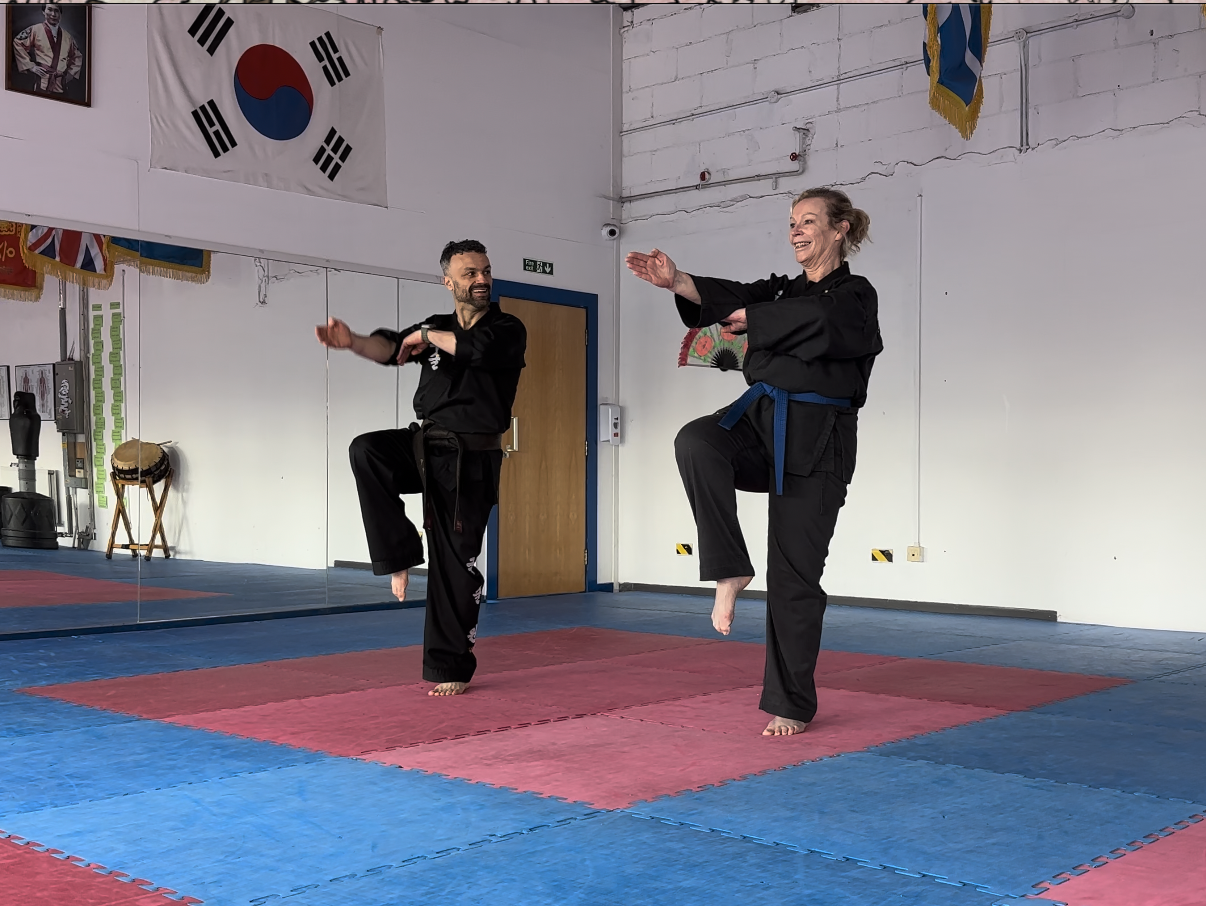 the form, the rest of the syllabus and, hopefully, for the rest of your life.
You’re not learning Kuk Sool with us just to get a different coloured belt; you’re learning because you want to get fit, be strong, learn self-defence, or a multitude of different reasons. Whatever those reasons are, you’ve got nothing if you’re not moving right.
And moving right doesn’t mean that everyone has to move identically. We’re all built differently, with different proportions, strengths, limitations and histories. What works beautifully for one person might require some adjustment for another. Good movement is about understanding how your particular body works, not forcing everyone into precisely the same shape. I would never expect perfection, but I do expect an understanding of what we’re trying to achieve.
A few years ago, I was overseeing a group of DBNs (brown belt students grading for their black belt) at a national grading event. As the test progressed, I noticed some of the students beginning to struggle with their movement mechanics. Shoulders were rounding, backs were bending, knees were falling inwards and movements were becoming increasingly incomplete; fatigue has a wonderful way of exposing weaknesses that we might otherwise get away with.
I stopped the group a few times and reminded them that complete movements, taking their time and maintaining good body mechanics were essential to both enjoying the test and getting through it in one piece. Unfortunately, one student eventually had to sit out with a strained back. I can’t say exactly what caused that injury, and I’m not about to pretend that I can diagnose someone’s back from across a sports hall, but watching movement deteriorate as people become tired certainly reinforces why I teach the way I do.
You see, the entire body is connected; it doesn’t operate as a collection of independent parts that occasionally agree to work together. A punch isn’t simply an arm movement, a kick isn’t just a leg movement, and having strong muscles doesn’t automatically mean you’re using them effectively.
If your upper body is moving poorly, the problem might begin much further down the chain. If your joint alignment in the lower body is off, other parts of your body may need to compensate. Sometimes you won’t even notice it happening until a muscle that was never supposed to be doing quite so much work decides it’s had enough.
And, as most of us discover eventually, the body has a particularly unpleasant way of informing us when we’ve been asking too much of it. Sometimes the bit that complains isn’t even close to the bit you were doing wrong.
Which reminds me of something from my engineering days, and here’s one of my tangential stories. Those of you who train with me will be familiar with these. I usually manage to bring them back around to something relevant eventually, although I suspect there are a few students still waiting for the point of a story I told them in 2017.
Before teaching martial arts became my career, I worked in engineering. Occasionally, we’d be called to investigate a piece of machinery making a peculiar noise. The noise was coming from the front, so naturally, that’s where we’d look. We’d climb underneath it, climb over it, inspect everything we could get our hands on and still find absolutely nothing wrong.
Eventually, we’d discover that the problem was at the other end of the machine. One of its feet had lost its connection to the floor. The entire frame was flexing under load, and the noise we were desperately trying to find at the front was simply the result of something going wrong at the back.
All that time investigating where the noise was coming from, when the actual problem was somewhere else entirely. Your body can behave in a surprisingly similar way.
Poor control or restricted movement at the ankle can influence what’s happening at the knee, which can influence the hip, the pelvis and the rest of the body. There are a multitude of reasons why people develop aches and pains, and I’m certainly not suggesting that every sore neck originated from a stiff toe, but the principle is worth understanding.
It’s that old song, isn’t it? The knee bone’s connected to the hip bone, the hip bone’s connected to the… well, you get the idea.
The human body is far more adaptable than a piece of industrial machinery, of course, and not every unusual movement is going to cause an injury. But consider someone performing a side kick without properly chambering the leg, rotating the standing foot or aligning the hips. They might get away with it once, or a hundred times, but repeat that movement another 20,000 times and you’re reinforcing the same poor mechanics… Injury isn’t inevitable, but it’s a risk I’d rather not spend years encouraging.
And that’s the point. It’s not just about whether you can perform a movement today; it’s about whether you’re developing movement habits that will serve you well for years to come.
The body is an incredible machine, but it can be a relentless bitch if you treat it badly.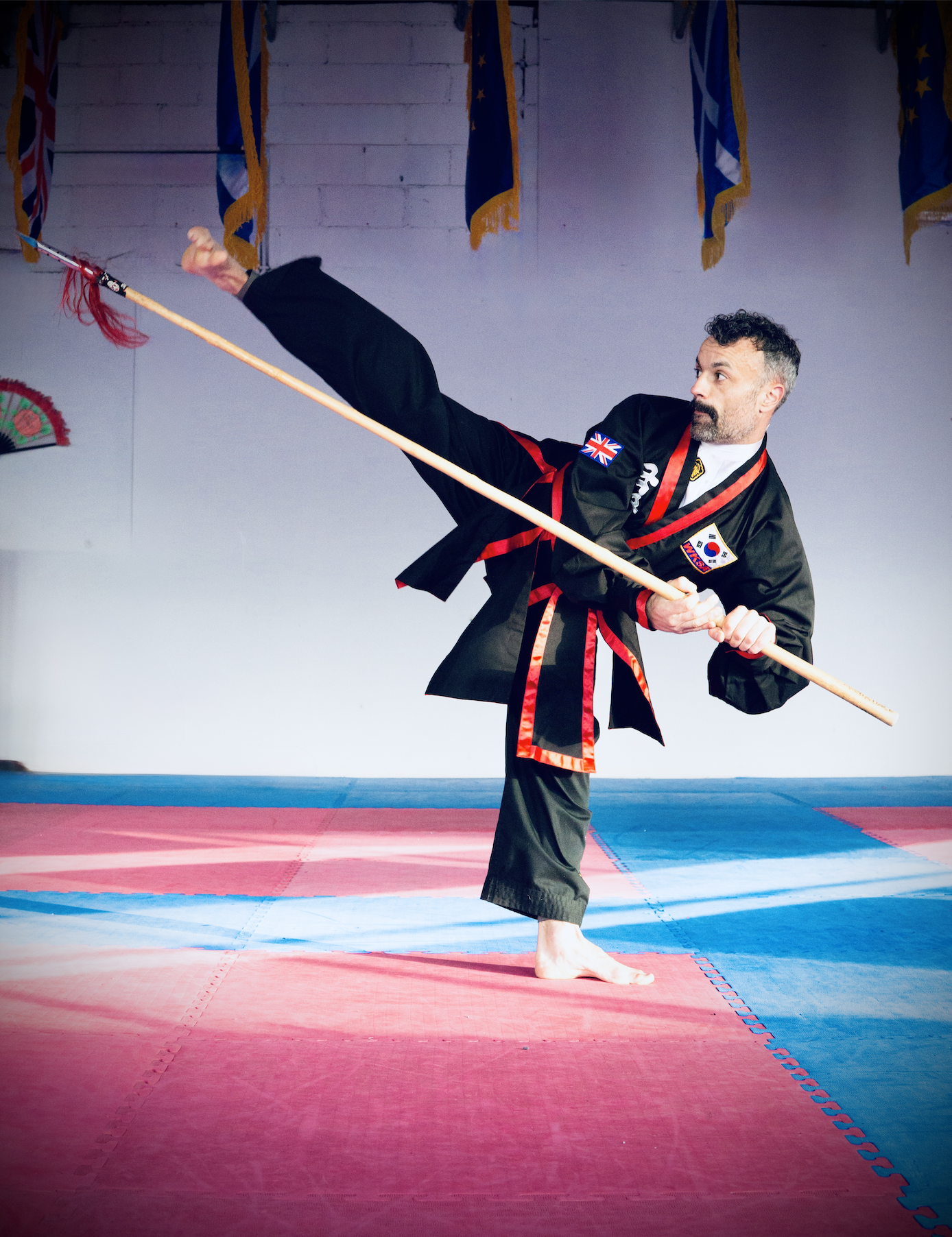
Now, before anyone writes to tell me that I’ve oversimplified human biomechanics, I’m well aware that there’s more to it than a few wonky joints and a machine that wasn’t bolted to the floor. These are observations drawn from years of teaching, training and working with mechanical systems. They’re my opinions, and if the science tells me I’ve got something wrong, I’m happy to learn from it. I’d much rather improve my understanding than spend the next twenty years confidently teaching something that’s incorrect.
We sometimes joke that confidence supersedes competence, but it doesn’t. Not in martial arts, not in teaching and certainly not in life. I’ve encountered plenty of people who are absolutely convinced they know everything there is to know, sometimes before they’ve even had the opportunity to learn it. A uniform, a rank or an impressive amount of self-confidence doesn’t automatically make someone competent. There’s a peculiar irony in how certain people can become about things they don’t fully understand, and I’ve always thought that the willingness to be corrected is a far better indication of someone’s knowledge than their insistence that they’re right.
Which, rather conveniently, brings me back to what I was talking about in the first place.
Why do we, as Widnes students, take so long to progress through the lower belts?
Is it because we’re obsessed with perfection? Is it because we care about how you might perform in thirty seconds of a tournament a year from now? No, it’s because it’s much easier to teach somebody to move well in the first place than to spend years undoing movements they’ve practised badly.
I have a few sayings that I regularly come back to when teaching.
One is: “You’re never too tired to do good hand strikes in your forms.”
Yes, you might raise your stance a little when you’re exhausted. You may kick a little lower, and your movements might not have quite the same energy they had twenty minutes earlier. But maintaining good hand strikes tells me that you’re still engaged with what you’re doing, still making an effort to control your body rather than just throwing your spaghetti arms around and hoping for the best.
When those hand strikes become sloppy, I often see other things beginning to deteriorate too. Shoulders round, posture
stoops, movements become incomplete and the body begins looking for easier ways to get the job done. It’s not that a poor hand strike magically causes your back to hurt, but it can be an indication that the attention you’ve been paying to your movement is beginning to disappear. And that’s precisely when I want you to pay more attention, not less.
Another saying is, “Teach it right, first time.”
Teach in detail, even to young white belts. Don’t assume that because a child is young, they can’t understand what you’re asking them to do.Explain it in a way they’ll understand, give them the opportunity to work it out and be patient while they learn.
They won’t necessarily get it right straight away. Some will take considerably longer than others, and that’s absolutely fine. There’s a difference between teaching something correctly from the beginning and expecting someone to perform it perfectly on their first attempt. But give them the understanding, and they’ll begin to develop the ability to recognise when something doesn’t feel right, make their own corrections and take responsibility for how they move. These students are much easier to teach when they’re black belts, because they’ve learned how to learn, rather than simply waiting to be shown what comes next.
That’s something they can carry into everything they do, not just Kuk Sool.
So, when I spend an entire lesson correcting the same movement, or ask you to repeat something you’ve already practised hundreds of times, it’s not because I’m trying t
o slow you down. It’s because I genuinely believe that the time invested in getting those foundations right will pay you back many times over.
I want you to understand your body, not just memorise a collection of techniques. I want you to be able to train hard, move efficiently, develop strength and confidence, and still enjoy doing it many years from now.
I don’t care whether it takes you three weeks or three months to learn those first movements. I care about what you’ve learned by the time you can perform them.
And if you take nothing else away from these Thursday morning ramblings, take this: before you worry about how much you can do, learn to do what you’re doing properly.
Oh, and there’s one final saying that’s become something of an unofficial school motto.
“Don’t be shit.”
It has absolutely nothing to do with movement mechanics, but I think it’s generally worth considering.
Karl Martindale
Master Instructor, Widnes Martial Arts